- 21/10/2026
- Tags: Dolpo
- Himalayan Wander Walkers
Reflections on the Dolpo region Trek of Nepal
Reflections on the Dolpo region of Nepal: (Originally written on 22 July 2026)
Below are thoughts and reflections after trekking in the Dolpo region of Nepal between May and June 2026. Some of these reflections are informed by discussions I was so grateful to have with Dolpapa (residents in Dolpo), and other reflections are informed by my experiences in Canada and around the world over 30 years of working towards more sustainable land and natural resource use. I am so grateful to Himalayan Wander Walkers for organizing and guiding the trek, and to the Altitude Project which provided so much background information and direct connections with people in and from the Dolpo region.
On this page 8 sections
- 01 Sharing insights from meetings in May-June 2026 By Gabrielle Kissinger (our Dolpo trek guest)
- 02 Climate change in the Dolpo
- 03 Road construction
- 04 Changes in pasture and livestock rearing
- 05 The interaction between education and livelihoods
- 06 Livelihoods so people can stay in the Dolpo
- 07 Looking to the future—what can be done?
- 08 Based on the above, there are further questions to explore, including:
Sharing insights from meetings in May-June 2026 By Gabrielle Kissinger (our Dolpo trek guest)
Based on what I observed, I believe this region is in a transition, and the direction that it is heading will likely not support the cultural, social and environmental values that make this region so special. Below I share why this is, and what could be done about it. My intention is to bring research and knowledge together in one place, to help inform people who care about and live in the Dolpo. If you are interested to follow the links in the footnotes for more detail, you can dig deeper into the sources of information that I drew upon. The pace of change coming, and the synergies between the types of change—such as road development, climate change impacts, shifts in livelihoods, and social structures—do not give Dolpapa much time to adapt. Within a few years, opportunities that exist today, such as how to direct change in a way that reflects Tibetan Buddhist values, will be gone.
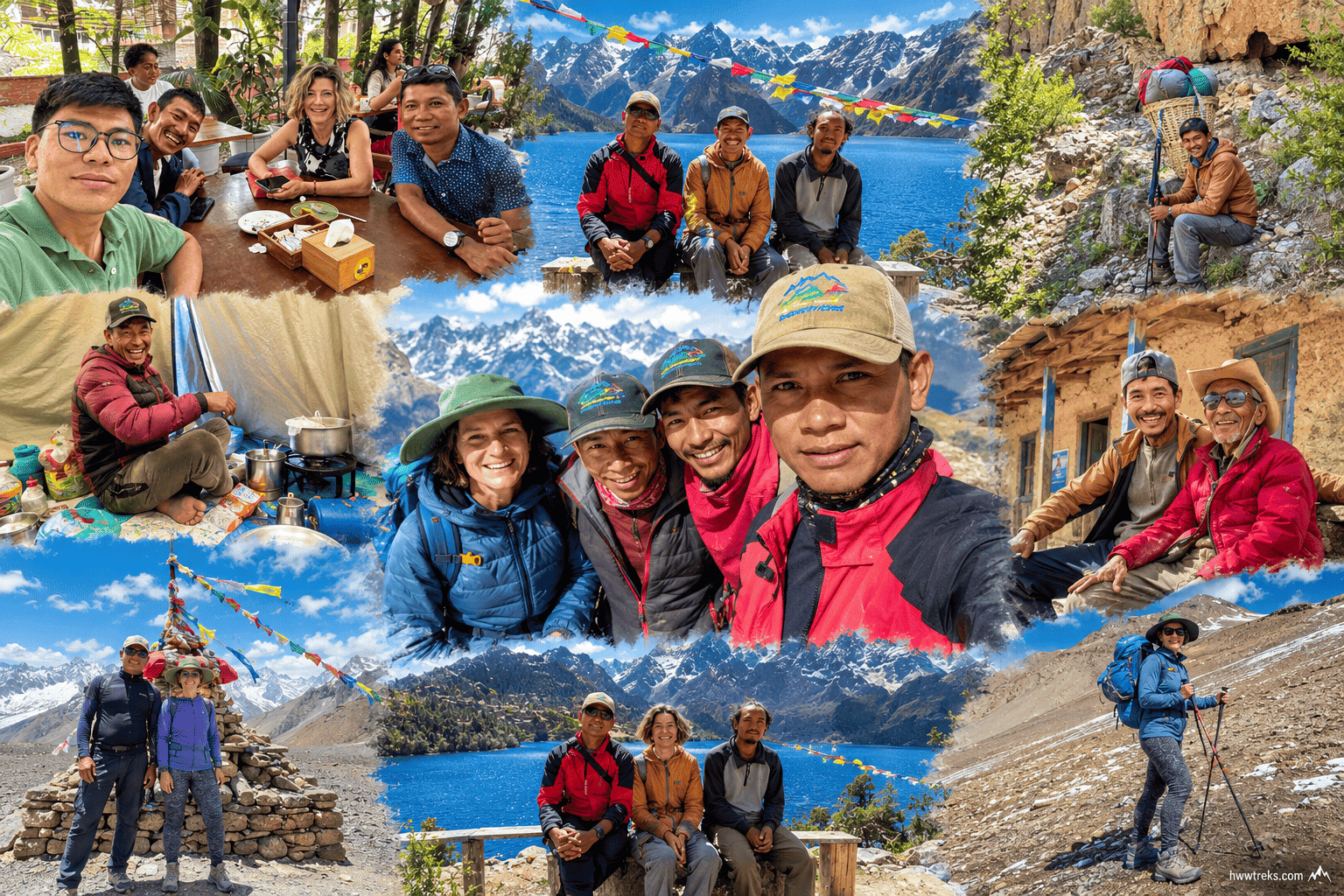
The main reason the Dolpo was of such great interest to me, besides wanting to explore a remote Himalayan landscape, was because it is a Tibetan Buddhist area, and one of the few that exists outside Tibet, besides Bhutan. Tibetan Buddhism in Tibet has suffered such repression under Chinese rule since the 1950s. Upper Dolpo has been able to persist likely for around 1500 years as a Tibetan Buddhist society, largely self-sustaining.
Little did I know when I booked the trip for mid-May to mid-June that villages would be mostly empty, and only elders and young children were left, while everyone else ascended to the Yarsagumba (cordycepts / Ophiocordyceps sinensis) harvesting areas in alpine grasslands. Thus, many monasteries were also closed during this time.
The first major observation to share is the pace of change coming to the Dolpo. The two types of change—climate impacts on this fragile sub-alpine and alpine environment, and socio-economic development changes—interact together in synergistic ways which I describe below.
Climate change in the Dolpo
I did not realize it would get so warm at such a high elevation, and I joked with my guide that flip-flops were not on the packing list. Karnali Province, in which Dolpo sits, joins a few other provinces in Nepal as having the greatest increases from ‘normal’ temperatures in December (winter) due to climate change—reaching +3 Celcius above normal, and the impact is greater at higher altitudes.1 For rising temperatures, this is double the global average.2 Since 1980 the decrease in snow cover in the region is significant. There is less snowfall in winter, and an earlier snowmelt in spring, and overall there is an increasing conversion of snow to rain. Precipitation amounts between higher and lower elevations differ, with higher elevations exhibiting lower precipitation due to reduced snowfall, while the middle altitudes have become wetter. 3 There are more concentrated extreme rainfall events that are interspersed with drier periods.4 Permafrost thawing due to climate change is having a bigger impact than glacial retreat in this region. The decrease in rainfall, drier climate, loss of permafrost, and increase in temperatures negatively impacts pasture, Yarsagumba abundance, reduces water availability for drinking, irrigation and other purposes, and impacts traditional livelihoods.5 Climate-induced habitat shifts are shifting interactions between livestock and wild species such as blue sheep, tahr and snow leopard, leading to more human-wildlife conflict. Yet these impacts are not well understood by local people. A 2022 rural households survey in Shey Phoksundo National Park found that although all households reported pasture scarcity and degradation over the past ten years, only half of the households believed climate change was to blame for the deterioration.6 This indicates a strong need to boost education on climate change and its impacts on livelihoods with local communities. Below I’ll explore more about how climate is impacting livelihoods.
Road construction
Although I was in Shey-Phoksundo National Park, there were roads being constructed in all corners of this region. As I huffed up the trail towards the top of Nagdala Pass (5,300 meters), rather than spotting a snow leopard in the rocks, I watched two motorbikes blast noisily along a road nearby. The Nepal government made a commitment some years ago to build a road to every sizeable village in the country.7 I assume this policy commitment was made regardless of land protection category, including national parks. As a foreign tourist who paid large permit fees 8 to enter the Park and access the Upper Dolpo in search of a wilderness experience, this sure came as a surprise. The motorbikes are a novelty for young people in the region, and everyone I spoke to marvelled at the speed at which they can transport materials, get sick people to health centers, and go visit relatives in other villages. But road access to remote regions brings unwanted things as well, such as theft, habitat degradation, and illegal activity. One review notes Dolpapa have experienced both greater mobility as well as increased vulnerability with infrastructure development, including disruptions in the social fabric and pastoral lifestyle. 9 Research on Nepal’s road-building and the associated social and economic benefits and costs shows that the negative consequences have often been underestimated and unmanaged.10 And once one road goes into a remote area, it is followed by many other roads. In nearby Ladakh, the water scarcity, waste, pollution and other negative impacts associated with rapid tourism growth only started when the road access was dramatically increased about twenty years ago.11 Ladakh has a similar environment as Dolpo, and social/cultural characteristics, so their experiences are very relevant. How ironic that road access into the Dolpo is also a major priority for the Chinese government, which views access through Nepal to India and beyond as strategic for its Belt and Road Initiative. This is not intended to benefit the Dolpapa, but rather serves China’s global development and investment portfolio interests, as well as enabling Chinese surveillance of and extraterritorial power over what are viewed from Beijing as potentially restive ethnically Tibetan populations outside of China’s borders.
Changes in pasture and livestock rearing
The new and growing reliance on Chinese motorcycles is also making horses and yaks redundant. This is exacerbated by the climate impacts in the region, which has degraded pastures. People do find the motorbikes easier to care for than animals, as all one must do is fill the gas tank. But the movement away from animals, which are also the source of manure for household farming, and a source of milk/yoghurt and income, not to mention icons of Dolpapa culture, is worrisome. Where will people get the money to buy the fuel necessary for their motorbikes? What does it mean for households to shift from what was a bartering and sharing economy to a cash economy? Will manure just come from goats? What are the impacts on Dolpapa culture to step away from animals?
Dolpapa pastoralism has evolved over 1000 years and probably much more, informed by Lamas and elders and age-old traditions and rules of rotational and deferred livestock grazing with specific species and herder groups, and Amchis' knowledge and cultural dimension of medicinal plant harvesting, all of which were systematic and sustainable. Domesticated yaks (Bos grunniens), preferred by many Dolpapa and valued for transport, meat and wool, are increasingly being sold off or let go. The reason for abandoning yaks is rising costs, climate change, lack of local markets for yak produce, frequent spread of diseases and other socioeconomic pressures such as outmigration. The melting of permafrost changes how water circulates in pastures, changing the timing and availability of moisture. This has also impacted wild yak (Bos mutus) populations. Many yak herders used to cross the border into Tibet for grazing and trading, spreading grazing over large areas. As more herders shift to other livestock such as goats, this increases pressure on pasture. The patterns observed in the Dolpo are also occurring elsewhere across Nepal’s’ Himalaya.
The interaction between education and livelihoods
I was so grateful to see the primary schools that have been built over the past 20 years with international assistance, mostly coming from trekkers who took it upon themselves to raise money and support technical capacity, while also raising funds for long-term operations. The result is that many young people from the Dolpo received support to become educated and to better their lives. What a gift! Twenty years on, after the earliest of these schools were built, new issues arise. The first is the outflow of young people and talent to Pokhara, Kathmandu and beyond.
Villages are losing half of their school-aged population. Statistics for Shey Phoksundo Gaunpalika rural municipality show outmigration was 53% of the young people below the age of 14. About 61% of outmigration across all ages was for schooling.16 Research documenting a similar phenomenon in the Nubri, Tsum, and Mustang valleys shows that over a few decades, this creates a self-reinforcing cycle: every generation has fewer young adults available to continue farming and pastoralism, weakening the viability of ethnically Tibetan communities in the Himalayan highlands.
Many people told me that it is very rare for someone to return home after leaving the region to be educated. One reason is the lack of local jobs, another reason is the hardship of rural life. The government of Nepal, international donors and other sources of support have not, it seems, found ways to provide for local jobs. The government recognizes that its investment in Western Nepal and Karnali Province has been insufficient, and the new 2026 budget prioritizes this underserved region. Schools and health care are consistently mentioned by people I spoke to as the highest priorities. Schools should be funded by the government, teachers should be salaried and paid from public funds, and the same for health care and health care workers. But long-standing patterns of under-investment, corruption, and misallocation of funds is hard to undue, though the current government commits to tackle this head-on. Complicating the effectiveness of investment further is the remoteness of the region, which deters teachers and doctors/nurses from elsewhere in Nepal to stay beyond short-term contracts. Teachers who are originally from the Dolpo should be hired, rather than those from far away who have no intention to stay, as they are in a better position to provide a culturally attuned educational curriculum (e.g., some classes in Tibetan, Dolpo history).
Outmigration and the aging population means that at some point, it will become difficult to sustain institutions that depend on a critical mass of residents, such as schools, monasteries, communal irrigation, and reciprocal labor networks.
Livelihoods so people can stay in the Dolpo
Besides teaching and health care providers, what are the other jobs and livelihood opportunities that could be advanced? One option is for local people to better capitalize on the trekking tourists coming in. Homestays could provide revenue directly to local families, while providing tourists with a unique local experience. In Uttarakhand, India, people involved in this activity report it does provide income and benefits, but it is seasonal, and other sources of income are needed to sustain a family.19 Arunachal Pradesh, India, sets basic standards and requirements for homestays at the household level, and the state takes on the responsibility of providing financial support, training, marketing, and monitoring.20 Other livelihood opportunities that maintain local traditions include cheese making in Bhijer,21 yet that may be a unique example, as other areas lack local markets to sell cheese to, and transporting products to Kathmandu or other markets is costly.22 Perhaps higher value-added products such as wool blankets and finished products offer opportunities.
The main source of cash for people in the Dolpo currently is at high risk. Yarsagumba (Ophiocordyceps sinensis) is a high-value medicinal plant, part caterpillar and part fungus, yet its harvest levels are plummeting. The crash is attributed to habitat degradation, climate change (its production decreases as winter temperatures increase), and especially overexploitation.24 Interviews of Yarsagumba collectors in 2014 found they attribute declines in production to decreasing winter snow (66%), earlier spring snowmelt (52%), and warming (38%) as causes.25 More recent research affirms these perceptions, finding that changes in winter precipitation, temperature and presence of permafrost (Yarsagumba favours habitat just below this) have big impacts on its occurance. Combining the climate impacts with overharvesting yields a “double whammy” for Yarsagumba, reducing its ability to adapt to climate change and rebound from overharvesting.26 Furthermore, the market for Yarsagumba only accepts specimens which have not yet produced spores for reproduction. This means the Yarsagumba cannot reproduce, contributing to the downward spiral in their abundance. Anecdotal research indicates that in previous years collectors could find 150 to 200 pieces in a month, but now barely find 10-30 pieces.27 The decrease in quantity collected is also be attributed to the increasing number of collectors, which in the Dolpo has been staggering.
I could not find estimates on the number of Yarsagumba collectors in Phoksundo National Park. The Park charges higher collector permit fees for people from outside the municipality than those from within, and there appears to be no limit on the number of permits granted. This appears to be a perverse incentive for the Park—more permits granted means more revenue, without consideration for the sustainability of the resource. A five-day ban on collection was announced in early June while we were in the Dolpo, due to the unavailability of Yarsagumba, but this likely had little effect. Everyone I spoke to emphasized how negatively impacted Dolpapa are by the loss in their only source of cash income. Research in Jumla District (Garjyankot Village28) identified the poorest households(which also have the lowest earnings from Yarsagumba) have a higher reliance on this source of income, compared to other sources such as agriculture, non-timber forest products, and seasonal labour. This indicates that as harvest levels decrease, the impact on the poorest households will be greatest.
More generally, many local people I spoke to expressed concern about how National Park financial resources are used, and wonder why they do not see more community benefit. Shey Phoksundo National Park collects high visitor fees, and yet public information on how much revenue comes in, and how it is allocated seems unknown. There are existing regulations that mandate the categories of spending Buffer Zone Management Committee (BZMC) budgets must follow.30 Shey Phoksundo NP’s BZMC appears to have a much smaller budget than other national parks. A 2016 assessment of the Shey Phoksundo NP’s BZMC activities found they overwhelmingly focused on energy issues: 45% of funds went to alternative energy activities, of which 20% went to micro-hydropower systems (categorized as conservation), 13% supported solar set distribution and 12% was for improved cook stoves (categorized as development). The income generation and skills development category was only 4% of the budget, although according to the guidelines it should be 20% (the 4% went to nursery/plantation work).31 This indicates that in 2016 (which may not be reflective of recent budgets), income generation and skills development was under budgeted, and energy access received more support than recommended by the budget guidelines. Publicly reviewing National Park and BZMC budgets and opening up community discussions about budget priorities would be an opportunity to grow transparency and respond to community needs.
Looking to the future—what can be done?
Reflecting on all of the above, the first major observation is how much outside influences (climate change, roads, migration out of the region to find income) are shaping this Tibetan Buddhist culture and way of life. So many of the development pressures stand in opposition to Buddhist values. The growing desire for motorbikes, cell phones, social media, and all the trappings of western development leads to attachment, dependency, addiction, and the desire to always have more and whatever is newer and better. This consumptive mindset is rampant on social media, and characteristic of Chinese and Western society, which is driven by financial and economic values, not religious, societal, or family values. Dolpapa can influence and change these dynamics if there is collective will to do so. That is not at all evident now.
What would it look like if Dolpo’s development were shaped not by Western, Chinese or Nepali national priorities and market forces, but rather by Dolpapa society, including young people, lamas and elders? I reflect on my time working in Bhutan, a majority Tibetan Buddhist culture and political system. Bhutan is world famous for pioneering the concept of Gross National Happiness (GNH), to frame their vision of development, as an alternative to Gross Domestic Product (GDP), which places their cultural values and well-being above pure economic output. It seeks to find a balance, or middle-path, which is itself a Buddhist concept. Bhutan has benefitted greatly from tourism, but early on instituted a Sustainable Development Fee to reduce the number of tourists and ensure tourism benefitted local people by funding healthcare and education, sustainable development and environmental conservation. GNH measures indicators of success such as time spent with community, participation in religious and cultural activities, and family cohesion across generations. Rather than look to Western, Chinese and Nepali models of development, I think Bhutan has more to offer Dolpapa, given the religious and cultural similarities.
The second major observation is that the scale of climate change impacts is happening fast, and its impacts in the Dolpo are greater than at lower altitudes and other parts of the world. Rather than wait for the Nepali government to respond, or international organizations to step in and offer solutions, I think there is much that local government and communities can do. I work on better governance solutions to respond to climate change (such as in Bhutan, Myanmar, Vietnam, Indonesia and other countries), so spend a lot of time researching and working on policy changes to affect change mostly in the agriculture and forestry sectors. Many policy changes and projects I have seen implemented in other developing countries barely reach farmers and villagers. However, there is much that can be driven from the local and community level. What is required first is to have a clear, scientifically (including traditional, indigenous knowledge) informed sense of the problems and how they impact locally, charting all the complex interactions between environmental, biophysical, social, economic and other factors. Then, solutions can be sought to solve those problems. When local people are part of a process to collectively identify the problems, seek input, and then collectively agree to solutions, they learn in the process and feel committed to the solutions. And there are locally attuned solutions that can be implemented with small budgets and local skills. Once example is the ice stupas that have been developed in Ladakh, by Sonam Wangchuk, as a way to capture water at night in winter, freeze it into a stupa shape, so that by spring, when farmers need water, they can collect it from the ice stupa.32 Given the scale of climate and overharvesting impacts on Yarsagumba, the main source of cash income, and the lack of knowledge and understanding among local people of these dynamics,33 this is a high priority for local collective action.
Based on the above, there are further questions to explore, including:
- What livelihood activities can be promoted and developed that supports the cultural and societal integrity of Tibetan Buddhists in Dolpo? This is a high priority given the pressures on Yarsagumba, and also because of the high outmigration.
- What type of tourism is beneficial to the cultural and ecological integrity of this region? Is it motorized (which will come if there are roads), or is it finding ways to derive more income from trekkers?
- What type of transportation is suitable for this high-altitude region, and how can the downsides be mitigated? This is related to the question about tourism, because increasing motorbike tourism will negatively impact the quality of trekking (trekkers are less likely pay large sums of money to hike on roads amidst motorcycles).
- How can local people have a voice in envisioning what their future should look like? What are the convening mechanisms to enable this, especially young and old, secular and monastic, people in the region and those who have left?
Collectively exploring the above points could guide Dolpapa towards a vision for their future, and form a basis to push for the change they want. If not, the doors of opportunity will likely start to close soon.